Education Intelligence Platform
Transforming education policy with AI-driven insights for developing nations
Context
The Education Intelligence Platform is an AI-powered tool designed to help government officials in developing countries make data-driven decisions about student outcomes and intervention programs. Built in partnership with the Tony Blair Institute for Global Change, the platform addresses critical education challenges such as student dropout rates, chronic school absenteeism, and learning poverty.
I served as Principal UX Designer for over 9 months, designing the platform in collaboration with Tony Blair Institute experts, government officials across multiple countries, and Oracle Digital Government product and engineering teams. Larry Ellison, founder and CTO of Oracle, and Tony Blair, former Prime Minister of the UK, were directly involved in this project as well.
Problem
Government officials in developing nations face critical education challenges (high dropout rates, chronic absenteeism, learning poverty, and more) but lacked tools to make data-driven decisions about where to invest limited resources.
School data was fragmented across disconnected systems, making it impossible to identify at-risk students or predict which interventions would work. Officials made decisions reactively based on incomplete information, often wasting education budgets on programs that didn't address root causes.
Without technology infrastructure for remote connectivity and with complex political dynamics across different countries, any solution needed to work affordably in resource-constrained environments while respecting cultural and governmental differences.
The challenge: transform fragmented data into actionable AI insights that government officials could trust and act on to improve student outcomes across millions of students.
Approach
Since end users were government officials in developing nations without technology infrastructure for remote connection, I worked closely with Tony Blair Institute experts who understood local political dynamics. With limited knowledge about solving this problem effectively, I started with an MVP design concept, using stakeholder reactions to identify product strategy quickly.
I designed the platform to transform fragmented school data into three interconnected capabilities: AI-powered predictions to identify at-risk students, simulation tools to test interventions before implementation, and cohort tracking to measure real-world effectiveness.
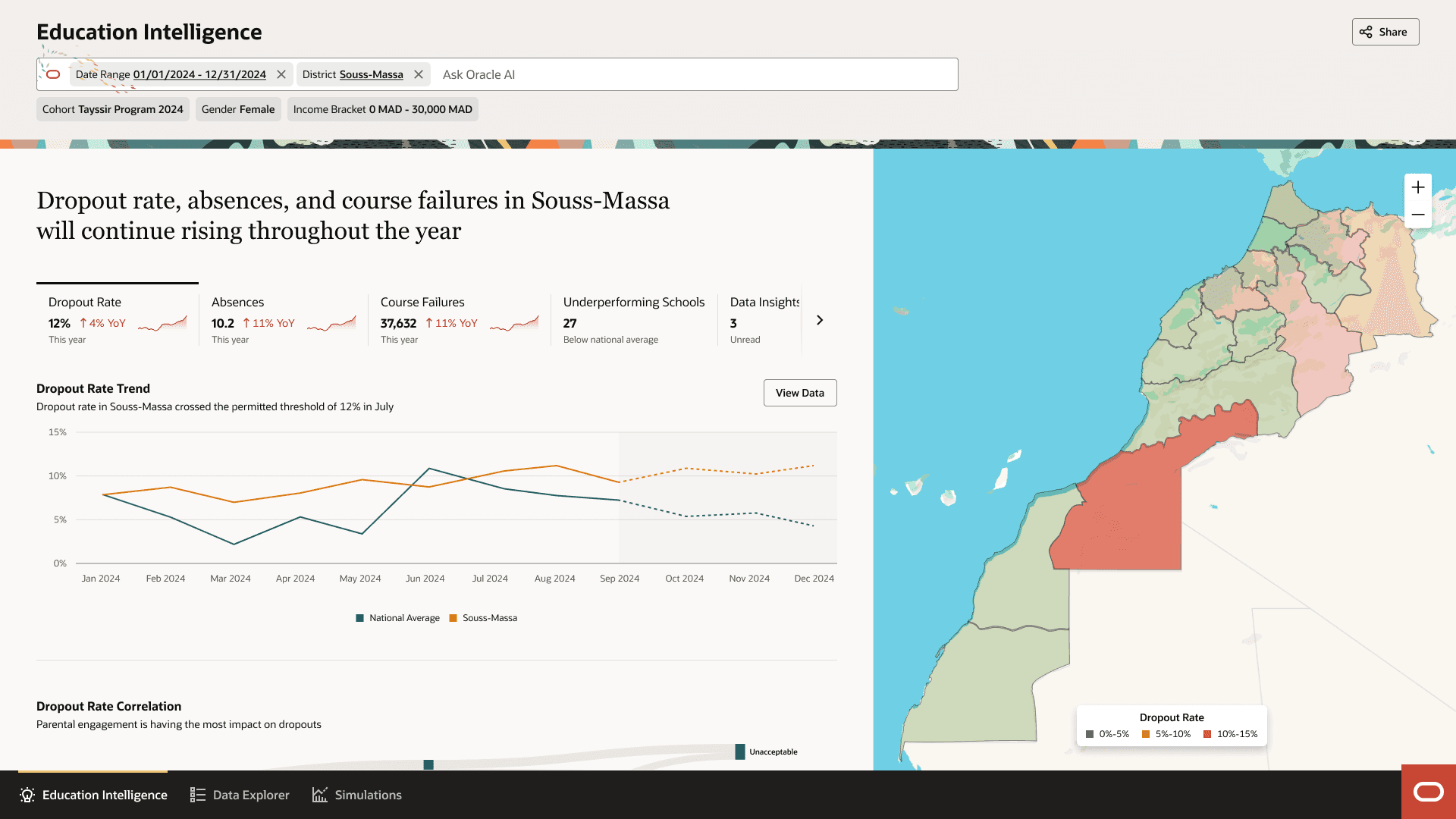
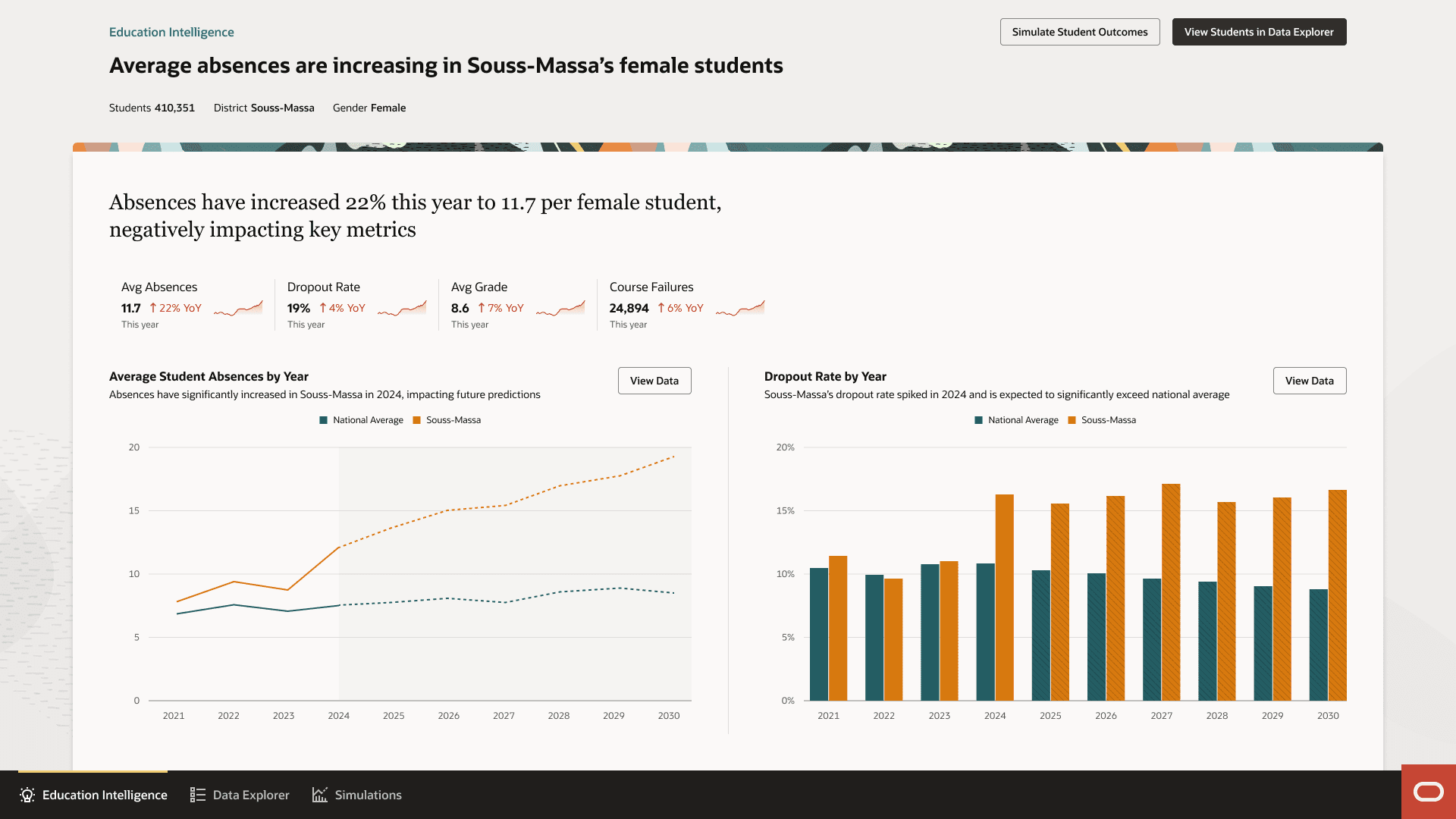
A critical design principle guided the AI work: use data insights to lead users to conclusions rather than letting AI make potentially biased assumptions. For example, if the system detects absences increasing among female students in a region, it generates insights with predictions about dropout impact and highlights correlation factors (parental engagement, school sanitation, family income, etc.) rather than making definitive statements about root causes.
The platform was built using low-code technology to keep costs manageable for developing nations with limited budgets, enabling 0 to 1 deployment in under two years. Interfaces were localized per country with language and metrics specific to each nation's education system.
Solution
AI-Powered Predictions
The Education Intelligence Platform uses AI to predict key education metrics and transform fragmented data into actionable insights about student outcomes.
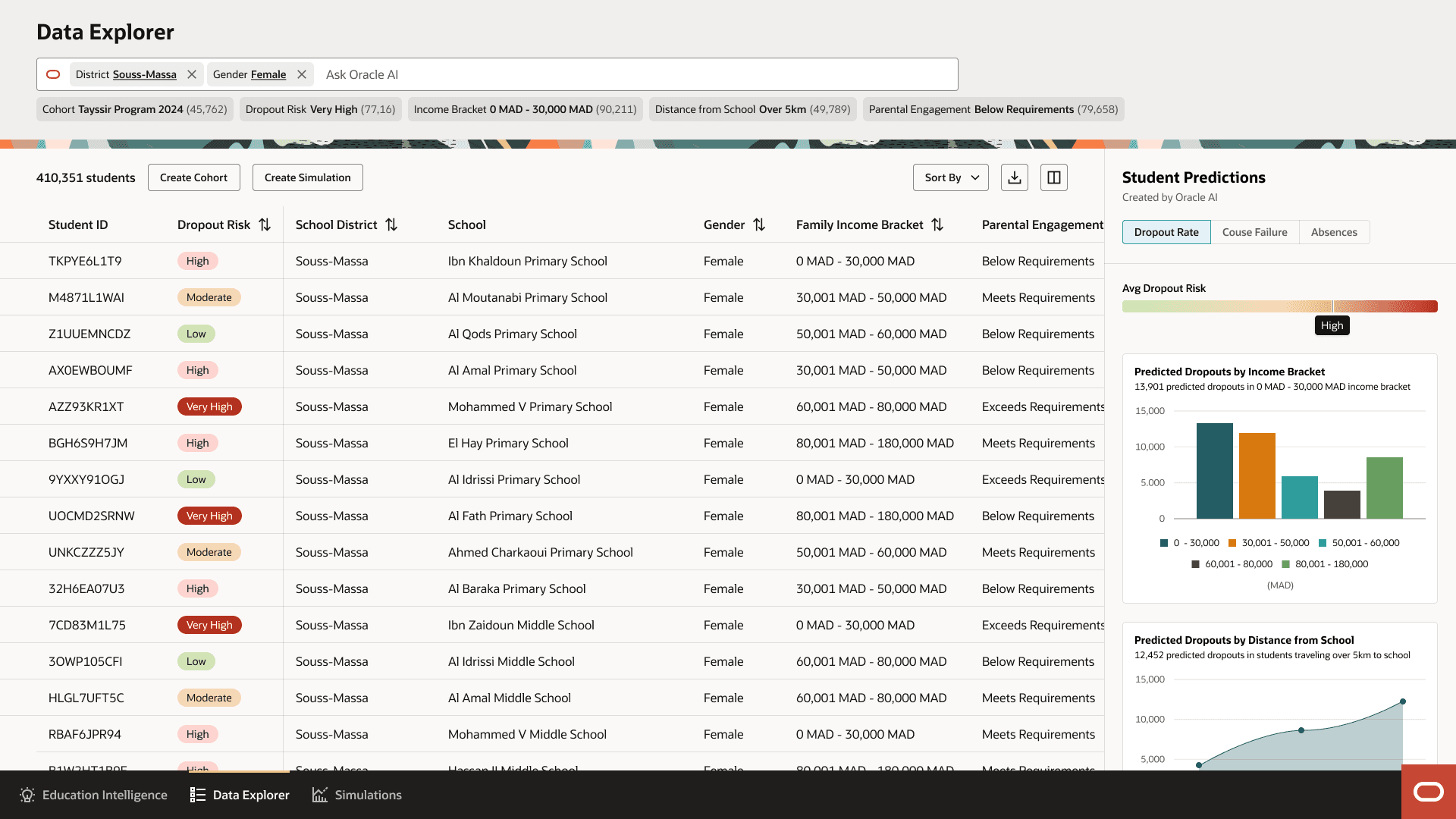
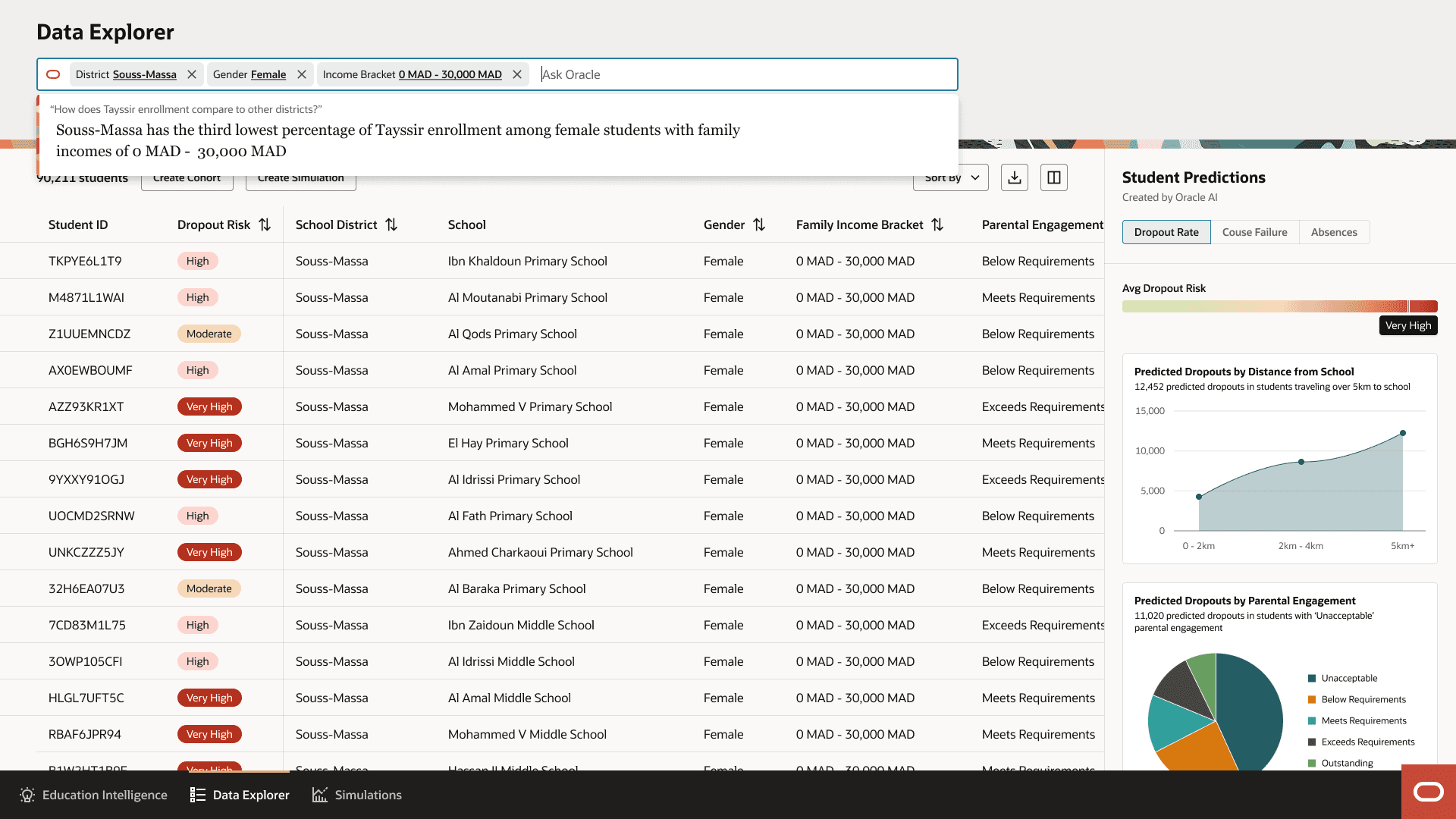
The Data Explorer provides open-ended analysis for building cohorts and exploring patterns. Officials can filter and segment students by any combination of factors (region, school, gender, income, attendance, etc.) to create targeted groups for intervention.
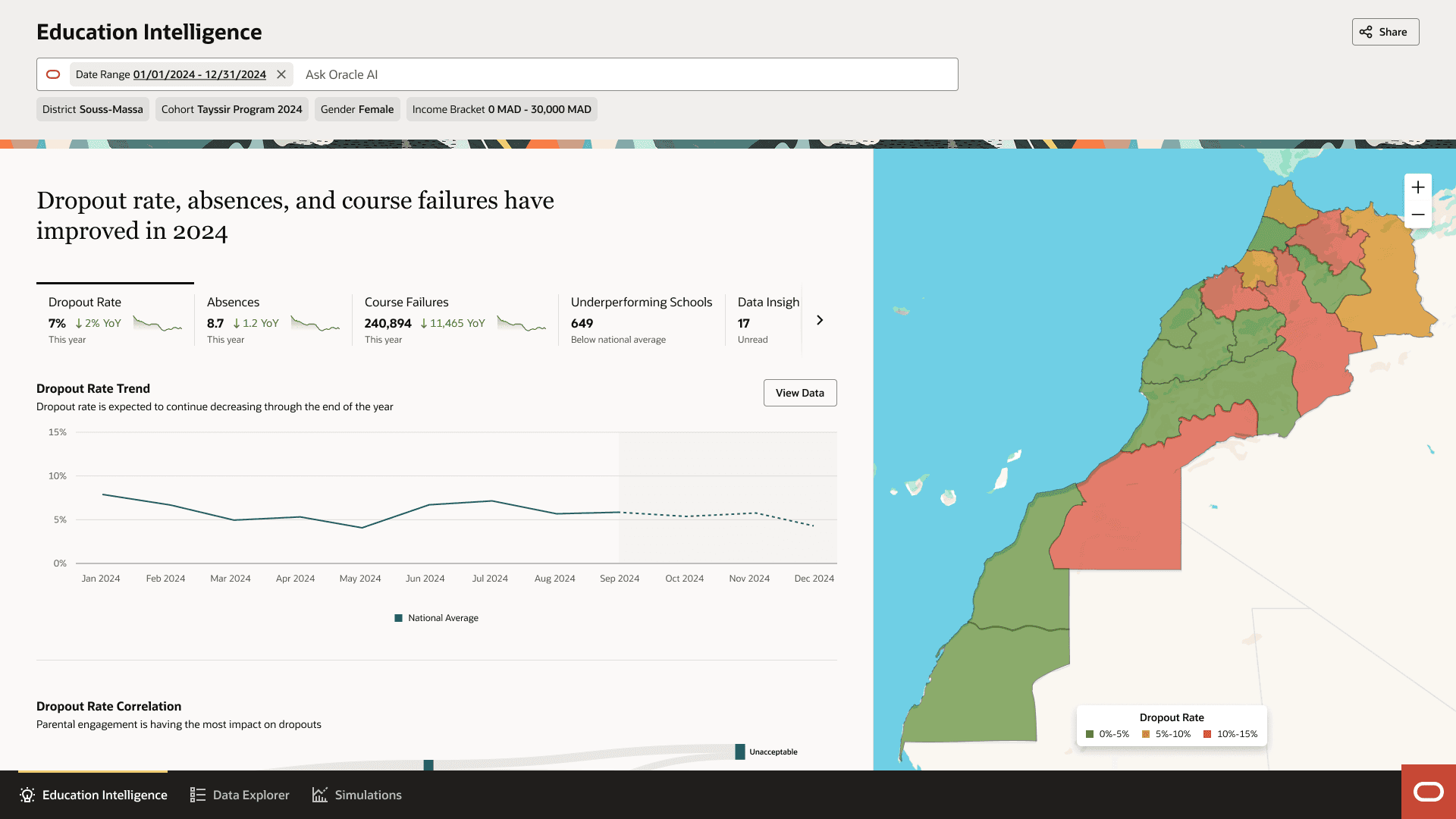
AI predictions identify dropout risk, expected absences, course failures, and underperforming schools at multiple levels. Officials can view regional performance patterns on map-based visualizations, drill down to school-level insights, then examine individual student predictions.
AI-generated insights surface patterns the system detects, like increasing absences among specific student demographics, and explain contributing factors with correlation analysis. Rather than declaring causation, the system highlights relationships between attendance patterns and factors like parental engagement, school sanitation, or family income, allowing officials to draw informed conclusions.
This ensures limited resources get directed toward students most likely to benefit from specific interventions rather than making decisions based on incomplete information.
Scenario Planning
Before committing scarce education budgets to interventions, officials need to understand which programs will actually work. Simulations allow governments to test different approaches and predict outcomes before implementation.
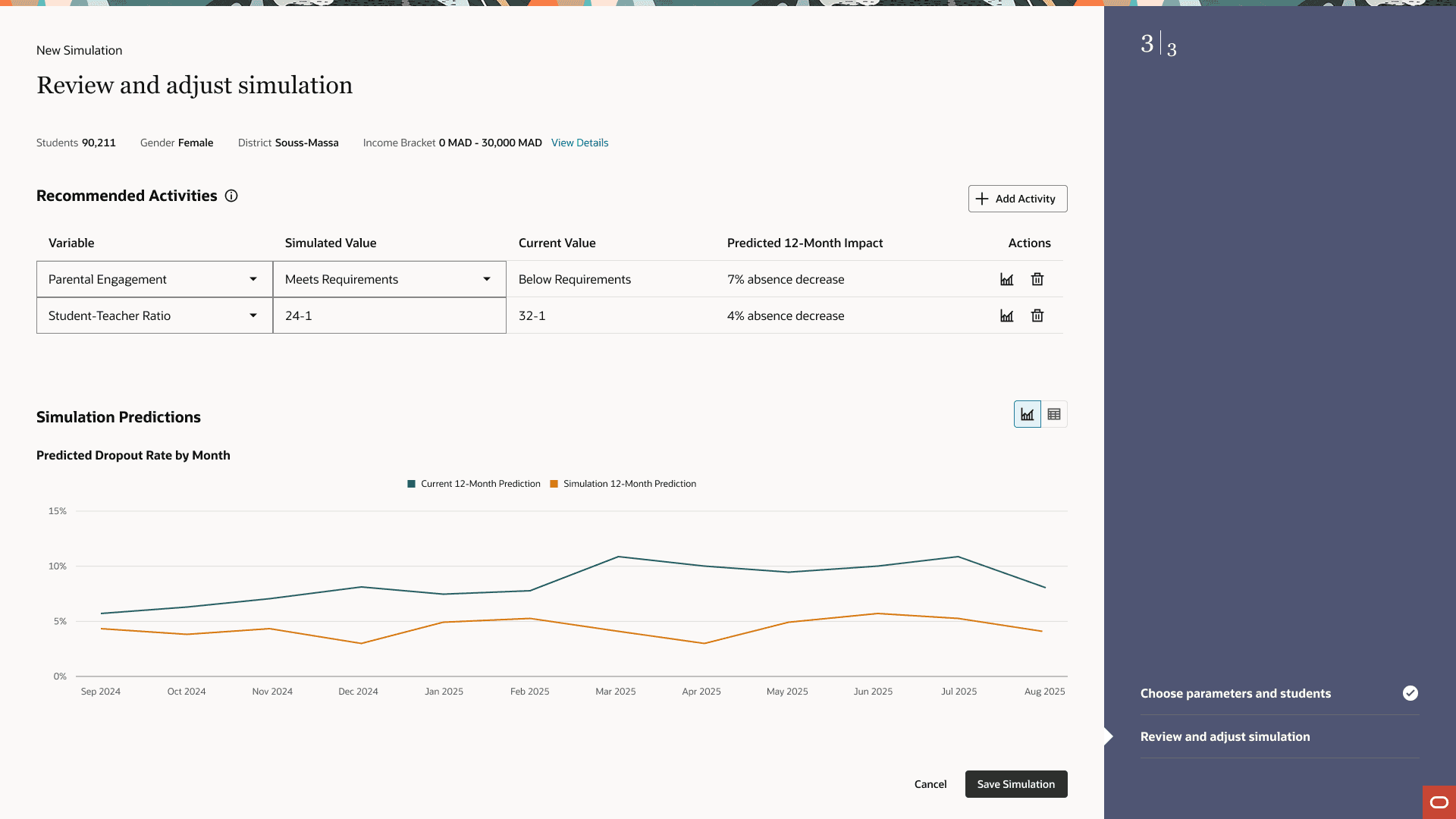
Officials define simulation goals, set parameters to exclude based on available resources (if there's no budget, exclude cash incentives for attendance, etc.), and receive AI-recommended activities to improve outcomes.
The system lets users experiment with different intervention strategies( adjusting program scope, duration, targeting criteria, etc.) and see predicted impact on student outcomes. Officials can compare multiple simulation scenarios side-by-side to identify the most effective use of limited resources.
Once simulations identify promising interventions, students can be enrolled directly into real programs for tracking, creating a seamless flow from planning to implementation.
Implementation Tracking
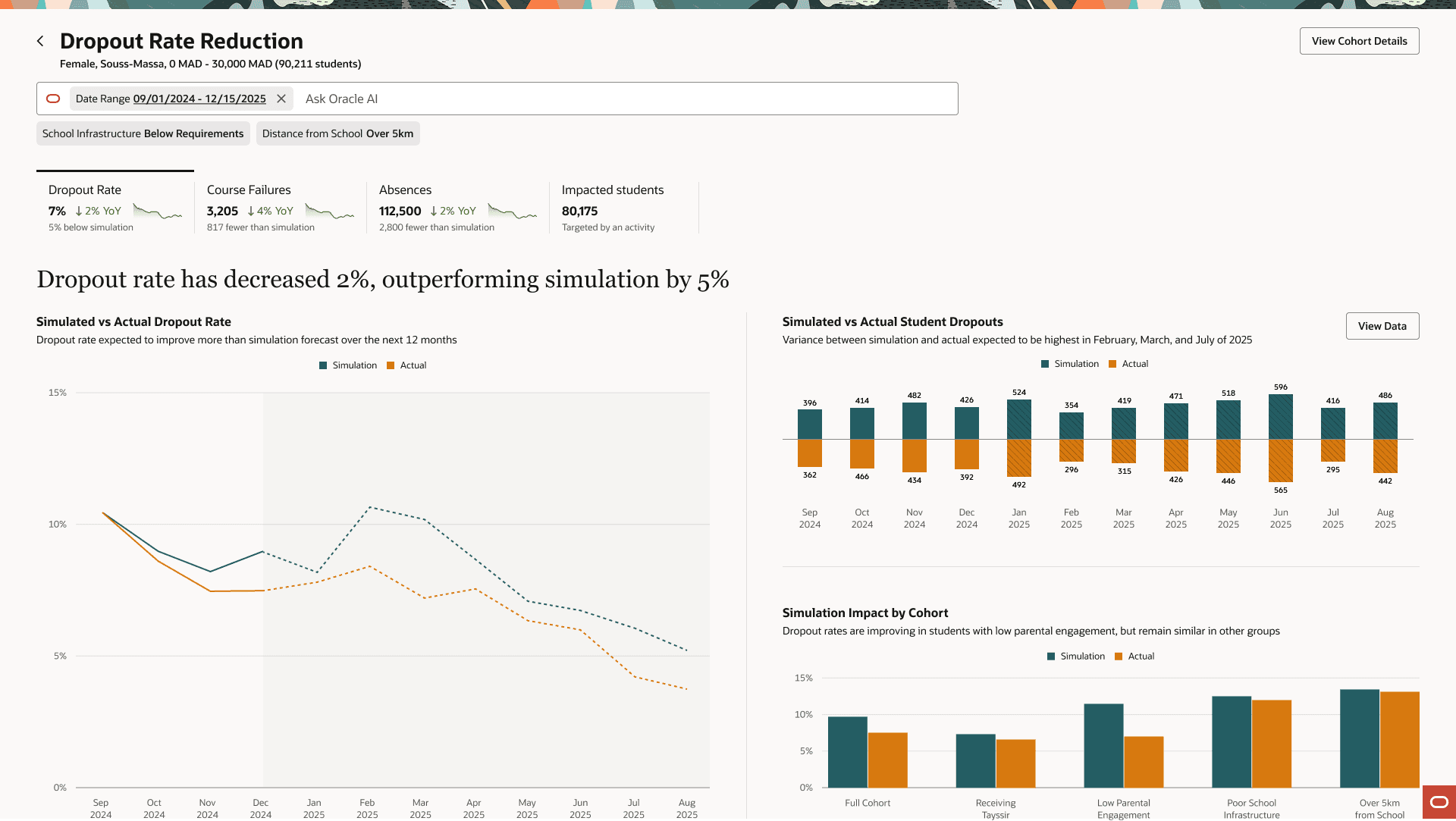
The Cohort Dashboard enables officials to move from planning to execution, measuring real-world program effectiveness and scaling successful interventions.
Officials enroll students directly from successful simulations into real intervention programs. The system tracks actual progress over time against control groups, showing whether interventions are achieving predicted outcomes.
Real-time data allows officials to make adjustments to ongoing programs as results come in, identifying what's working and quickly modifying ineffective approaches. Successful interventions can be scaled to larger populations while resources are redirected away from programs that aren't delivering results.
Officials can adjust AI recommendations based on local constraints and available resources, ensuring maximum impact and efficiency. This creates a feedback loop that improves future decision-making and maximizes the long-term impact of limited education budgets.
Impact
The platform deployed to four countries in under two years, creating a foundation for evidence-based education policy where none existed before. Oracle's founder, Larry Ellison, and Tony Blair, former Prime Minister of the UI, were directly involved in the project, reflecting its strategic importance.
The low-code development approach proved beneficial, enabling rapid deployment while keeping costs manageable for developing nations with limited technology budgets. We were able to deliver real-time insights in regions where data-driven education tools previously didn't exist, simulation capabilities that prevent wasted resources, impact tracking that creates accountability for education interventions, and a scalable foundation for evidence-based policy across multiple countries serving millions of students.
Beyond technical success, this project represents a fundamental shift in how education officials can approach student outcomes – creating tools that can keep individual students in school, break cycles of poverty, and drive economic growth for entire regions.
"I've worked with UX designers since 2010 and always had a bad experience until now. This is the first time I've worked with a UX designer that goes beyond visuals to really understand things. You've added a lot of value to the business side. This has turned out so much better than what I expected. I'm really impressed."
Hesham Ahmed
Product Manager, Education Intelligence Platform